
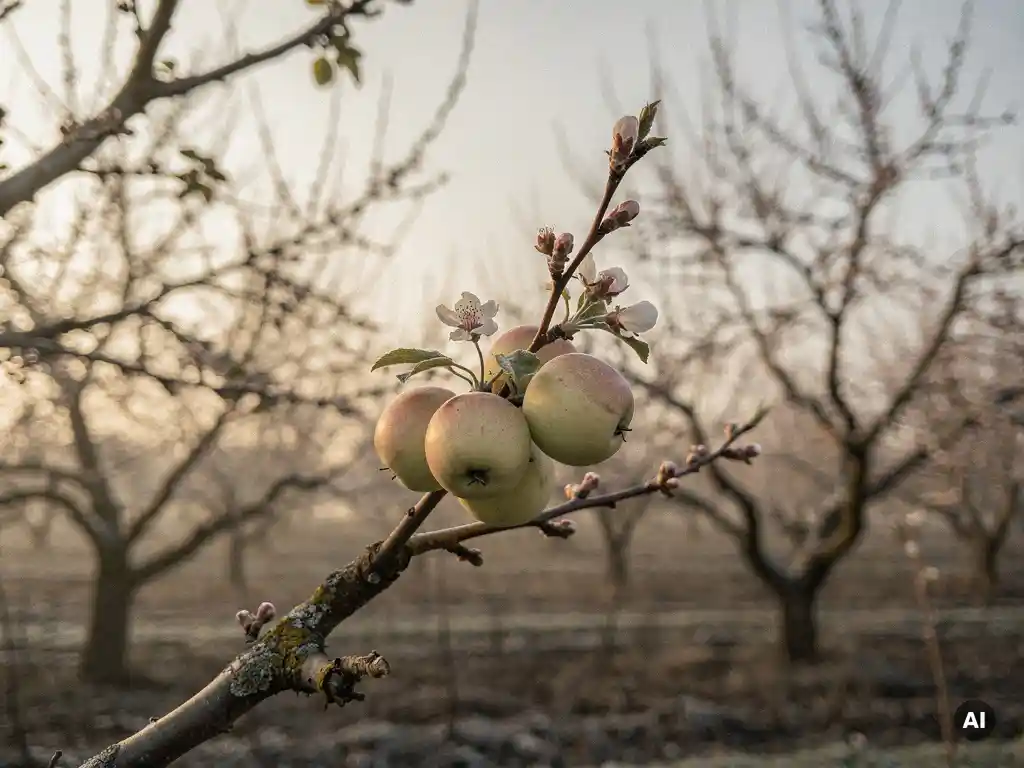
A mild winter can significantly reduce apple harvest quality and yield by depriving trees of the cold exposure they need to complete dormancy. Apple trees require a minimum number of chill hours each winter to reset their biological cycle, and without that, flowering becomes erratic, fruit set is poor, and the overall crop suffers. The questions below unpack exactly how this process works and what it means for growers and breeders alike. Feel free to get in touch with us if you want to learn more about how we approach these challenges in our breeding work.
What happens to apple trees during a mild winter?
During a mild winter, apple trees struggle to complete the dormancy phase they depend on for healthy spring growth. Dormancy is not simply a period of inactivity; it is an active biological process triggered by cold temperatures and short days, during which the tree resets its internal systems, conserves energy, and prepares for the next growing season. When winter temperatures stay too warm, this process is disrupted at a fundamental level.
In practical terms, trees that have not completed proper dormancy may produce fewer flower buds, open those buds unevenly, or fail to synchronise their growth stages. Leaves, flowers, and shoots can emerge at different times on the same tree, making pollination difficult and reducing the consistency of the fruit set. Growers may also notice weaker vegetative growth and a higher susceptibility to certain pests and diseases, since the tree has not had the chance to fully consolidate its defences during the winter rest period.
The warmer the winter and the longer the period of insufficient cold, the more pronounced these effects tend to be. In regions where mild winters are becoming more frequent, this is no longer an occasional inconvenience; it is a structural challenge for apple production.
How do chill hours affect apple blossom timing?
Chill hours are the number of hours during winter when temperatures fall within a range that promotes dormancy completion, typically between 0°C and 7°C. Apple trees need to accumulate a sufficient number of these chill hours before they can break dormancy and begin flowering in spring. Insufficient chill hours delay or disrupt blossom timing, which cascades into problems across the entire growing season.
When a tree has accumulated enough chill hours, it responds predictably to warming spring temperatures by producing flower buds in a coordinated, timely way. When chilling requirements are not met, the tree may still flower eventually, but the process becomes irregular. Some buds open early, others late, and the overall flowering window stretches out. This reduced synchrony makes effective pollination harder to achieve, since compatible varieties and pollinating insects may not be active at the right moment.
Different apple varieties have different chill hour requirements, which is why some varieties perform reliably in warmer climates while others are specifically suited to regions with cold, reliable winters. Understanding the chilling requirement of a variety is one of the most important factors in matching it to the right growing region.
Which apple varieties are most vulnerable to warm winters?
Apple varieties with high chill hour requirements are the most vulnerable to warm winters. These are typically varieties developed in or for regions with traditionally cold, reliable winters, where breeders did not need to select for low-chill tolerance. When grown in areas experiencing milder winters, these varieties consistently underperform in years when cold accumulation falls short.
High-chill varieties may show a range of symptoms in warm winters: delayed and uneven bud break, sparse flowering, poor fruit set, and misshapen or undersized fruit. Over several consecutive mild winters, the cumulative stress can weaken the tree’s long-term productivity and make it more vulnerable to secondary problems like fungal infections and pest pressure.
By contrast, varieties bred with lower chilling requirements, or those selected for resilience across a broader range of winter conditions, tend to maintain more consistent performance. As climate patterns shift, the commercial appeal of these more adaptable varieties is growing, and growers are increasingly factoring chilling requirements into their variety selection decisions alongside taste, yield, and disease resistance. You can explore the range of varieties we have developed with these challenges in mind on our variety overview.
Can a late frost after a mild winter damage the apple crop?
Yes, a late frost following a mild winter is one of the most damaging weather events an apple grower can face, and mild winters significantly increase this risk. When winter temperatures are warmer than usual, trees break dormancy earlier and begin flowering sooner. If a frost then occurs after blossom has opened, the delicate flower tissue is highly vulnerable to freezing damage, which can destroy the crop for that season entirely.
The danger is rooted in timing. A tree that has flowered two or three weeks earlier than normal due to insufficient chilling is exposed to frost risk for a longer period during spring. Frost events that would ordinarily occur before flowering now coincide with open blossoms or even early fruit development, when the tree has almost no tolerance for sub-zero temperatures.
Even a brief frost of a few hours at temperatures just below freezing can kill a significant proportion of open flowers. The result is a dramatically reduced fruit set, which directly translates into a poor harvest that autumn. In some cases, growers can use frost protection measures such as wind machines, overhead irrigation, or heaters in the orchard, but these are costly and not always sufficient when a hard frost arrives unexpectedly after an unusually warm early spring.
How are apple breeders responding to milder winters?
Apple breeders are actively incorporating climate resilience into their breeding strategies, with lower chilling requirements and broader adaptability becoming key selection criteria alongside traditional traits like taste, texture, and disease resistance. The goal is to develop varieties that perform consistently across a wider range of winter conditions, rather than depending on reliably cold winters that can no longer be guaranteed in many regions.
At Better3Fruit, climate resilience is one of our primary long-term breeding goals. We use molecular markers and other modern tools to identify and select the genetic traits that underpin dormancy behaviour and cold tolerance, allowing us to make more precise decisions earlier in the breeding process. With over 30,000 new varieties under evaluation at any one time, we have the scale to identify genuinely exceptional performers under a broad range of conditions.
Beyond low-chill tolerance, breeders are also looking at how varieties respond to the combination of a mild winter followed by a late frost, a scenario that is becoming more common in many apple-growing regions. Varieties that break dormancy more gradually, or that have some tolerance for late frost events at the blossom stage, are particularly valuable in this context. Breeding for climate resilience is not a single trait but a cluster of interacting characteristics, and addressing it well requires the kind of long-term, large-scale programme that produces durable, commercially viable results.
If you are a grower, retailer, or industry partner thinking about how shifting winter conditions might affect your apple production, we would be glad to talk through what our current and upcoming varieties can offer. Contact us to start the conversation.
This content was generated with the help of AI and it may contain mistakes