
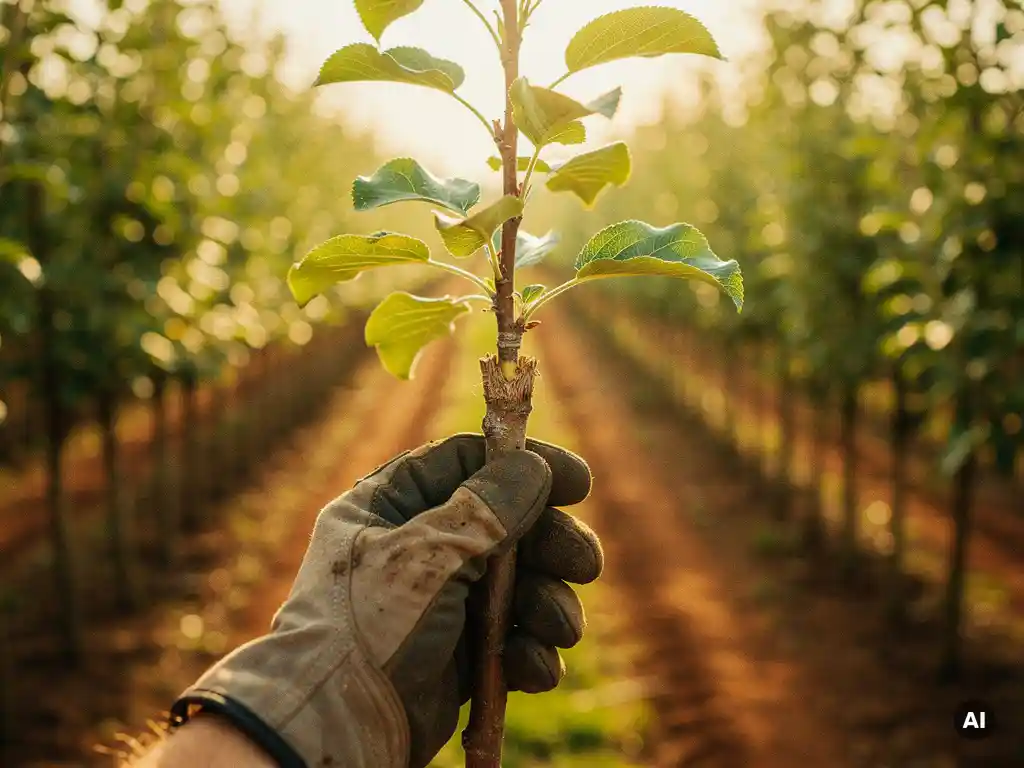
Clonal propagation ensures uniformity within an apple variety by producing genetically identical copies of a single parent plant. Because every tree in a clonal population carries exactly the same DNA, they express the same fruit colour, flavour, texture, and ripening behaviour season after season. The sections below unpack how this works in practice, from grafting mechanics to the implications for variety licensing and long-term genetic stability.
If you have questions about apple variety development or want to learn more about how we work at Better3Fruit, feel free to get in touch with us directly.
What makes clonal propagation different from growing apples from seed?
Clonal propagation reproduces a plant vegetatively, meaning no sexual reproduction is involved and no new genetic combinations are created. Every tree produced this way is a direct physical extension of the original parent plant, carrying an identical genome. Growing apples from seed, by contrast, produces offspring that are genetically unique because seeds result from the fertilisation of one parent’s egg cell by another parent’s pollen.
This distinction has enormous practical consequences. An apple grown from seed will almost never resemble either of its parents in a predictable way. The resulting tree might produce fruit that is smaller, more acidic, differently coloured, or simply unpalatable. This is why no commercial apple variety is ever propagated by seed. Vegetative propagation, which includes grafting, budding, and in some cases tissue culture, is the only reliable way to reproduce a variety’s exact characteristics at commercial scale.
The difference also explains why apple breeding is such a long-term endeavour. Breeders deliberately cross two parent varieties to create genetic diversity in the seedling population, then select the rare individual that combines all the desired traits. Once that individual is identified, clonal propagation locks in its genetics permanently.
How does grafting create genetically identical apple trees?
Grafting creates genetically identical apple trees by physically joining a cutting, called a scion, taken from the target variety onto a rooted rootstock plant. The scion provides all the above-ground growth, including the shoots, leaves, flowers, and fruit, while the rootstock contributes the root system. Because the scion is cut from an existing tree of the variety, it carries that variety’s exact genetic material.
The process works because the vascular tissues of the scion and rootstock fuse at the graft union, allowing water, nutrients, and sugars to move freely between them. Once the graft takes, the scion grows as if it were still part of the original tree. The rootstock has no influence on the fruit’s genetic identity, though it does affect tree vigour, size, and sometimes precocity.
Grafting is the dominant apple propagation method worldwide for this reason. A single outstanding mother tree can be multiplied into thousands of identical trees within a few propagation cycles, each one guaranteed to produce fruit with the same characteristics that made the original selection valuable. This is how a variety identified in a breeding programme can be scaled up for commercial orchards across multiple countries while maintaining absolute consistency.
What other propagation methods are used besides grafting?
Besides grafting, the main vegetative propagation methods used in apple production are budding, rooted cuttings, layering, and micropropagation through tissue culture. All of these methods share the same fundamental principle: new plants are generated from existing plant tissue rather than from seeds, so the genetic identity of the source plant is fully preserved.
- Budding is a variation of grafting where a single bud rather than a multi-bud scion is inserted into the rootstock. It is widely used in nursery production because it is efficient and requires less material from the source variety.
- Rooted cuttings involve taking shoots from a parent plant and encouraging them to form their own roots. This works well for some rootstocks but is less commonly used for scion varieties, which can be difficult to root.
- Layering bends a stem from the parent plant into the soil while it is still attached, allowing roots to form before the new plant is separated. Stool layering is a standard method for producing apple rootstocks such as the widely used Malling series.
- Micropropagation uses small pieces of plant tissue cultured in a sterile laboratory environment to generate large numbers of plants rapidly. It is particularly useful for producing disease-free planting material and for scaling up new varieties quickly after their initial release.
Each method has trade-offs in cost, speed, and scalability, but all achieve the same outcome: genetically uniform plants that express the variety’s defined characteristics reliably.
Why can’t uniform apple varieties be maintained through seeds?
Uniform apple varieties cannot be maintained through seeds because apples are highly heterozygous, meaning each parent carries two different versions of most genes. When two heterozygous parents cross, their offspring inherit random combinations of those gene variants, producing enormous variation. Even self-pollination of a single variety generates highly variable seedlings rather than true copies of the parent.
This biological reality is not a flaw but a feature when it comes to breeding. The genetic diversity produced by sexual reproduction is exactly what breeders work with when searching for new combinations of traits. At Better3Fruit, we evaluate tens of thousands of new seedlings every year, looking for the rare individuals that bring together superior taste, disease resistance, yield, and climate resilience in a single tree.
But once that exceptional individual is found, seeds are the last thing a breeder or grower wants to use for multiplication. The traits that make a variety commercially valuable, such as a specific flavour balance, a distinctive skin colour, or a particular texture, are the product of a unique genetic configuration that seeds will not replicate. Clonal propagation is the only way to preserve and reproduce that configuration faithfully across an entire commercial crop.
How does clonal propagation support apple variety licensing and IP protection?
Clonal propagation supports apple variety licensing and intellectual property protection by ensuring that a variety remains genetically defined and distinguishable. Because every licensed tree is a clone of the original selection, the variety can be precisely characterised, its traits can be verified, and any departure from those traits can be detected. This makes it possible to protect a variety through plant breeders’ rights and to enforce those rights meaningfully.
At Better3Fruit, our entire commercial model depends on this relationship between clonal identity and IP. We develop new apple and pear cultivars, protect them through plant variety rights, and then license them to growers and marketing organisations worldwide. The genetic consistency that clonal propagation provides is what makes a licensed variety a reliable, auditable product rather than a loosely defined type.
Licensing structures for club varieties, where production and marketing are coordinated across a defined network of licensed growers, rely on the assurance that every orchard in the programme is growing the same variety to the same standard. You can explore our current apple and pear varieties to see how this approach translates into distinct, commercially managed cultivars. Without clonal propagation, consistent quality control across international supply chains would simply not be achievable.
Can clonal propagation introduce genetic changes over time?
Clonal propagation can introduce small genetic changes over time, but these are rare and usually minor. The most common source of variation in clonally propagated apple trees is somatic mutation, where a spontaneous change occurs in a single cell during normal plant growth and is then passed on to the tissues that develop from that cell. If a mutation arises in a bud that is later used as a scion, the resulting tree will carry that change.
In practice, most somatic mutations are neutral or go unnoticed. Occasionally, however, a mutation affects a visible or commercially relevant trait, such as fruit colour or ripening time. Some well-known apple variants, called sports, originate this way. A grower noticed a branch producing fruit with a different colour pattern, propagated that branch clonally, and in some cases a new commercial strain emerged.
Accumulation of mutations across many propagation cycles is possible in theory, but the rate is low enough that it does not compromise variety integrity under normal nursery and orchard conditions. Micropropagation through tissue culture can sometimes introduce a different type of variation called somaclonal variation, which is why plant material produced this way is typically screened before commercial release.
Overall, the genetic stability of clonally propagated apple varieties is high enough to sustain consistent commercial production across decades, which is why grafting and related methods remain the foundation of the global apple industry.
Understanding how clonal propagation works is essential for anyone involved in apple variety development, licensing, or commercial growing. If you want to learn more about our breeding programme or discuss variety licensing opportunities, contact us and we will be happy to help.
This content was generated with the help of AI and it may contain mistakes