
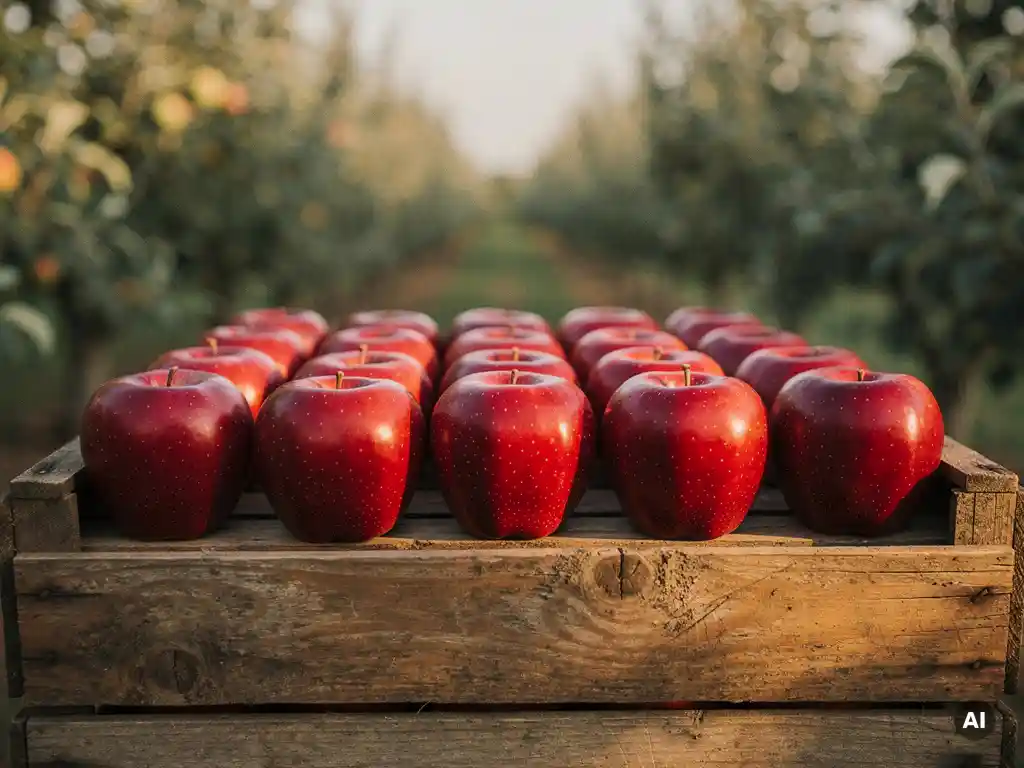
Uniformity is important in fruit varieties because it directly determines commercial value, grower profitability, and consumer satisfaction. A batch of apples that varies wildly in size, colour, or texture creates problems at every stage of the supply chain, from grading lines to supermarket shelves. The questions below unpack exactly why uniformity matters, how breeding influences it, and what threatens it in modern production.
At Better3Fruit, we are happy to help anyone curious about our varieties or breeding approach, so feel free to get in touch if you want to learn more directly.
How does fruit uniformity affect commercial value?
Fruit uniformity affects commercial value because retailers, packers, and exporters all operate within strict fruit grading standards that reward consistency and penalise variation. When a grower delivers a uniform batch, a higher percentage of the harvest meets the top grade, which commands the best price. Inconsistent fruit forces costly sorting, increases waste, and often results in downgraded product sold at lower margins.
Supermarkets in particular have demanding specifications for apple variety uniformity. Size windows, colour thresholds, and shape requirements are written into contracts, and batches that fall outside those parameters are either rejected or reclassified. For a grower working on thin margins, the financial difference between a 70% and a 90% pack-out rate can determine whether a season is profitable.
Beyond the farm gate, uniform fruit quality consistency builds trust with buyers. Retailers who know that a given variety reliably delivers the same appearance and eating experience will prioritise it in their ranging decisions. This is one reason why fruit quality consistency is not just a nice-to-have, but a commercial necessity for anyone supplying modern retail channels.
Why do growers care about uniformity within a single variety?
Growers care about uniformity within a single variety because it simplifies every operational decision they make, from harvest timing to storage management. When fruit within a variety ripens at the same rate and reaches a consistent size, growers can schedule picking windows efficiently, reduce labour costs, and fill storage facilities with product that will behave predictably over time.
Harvest timing is particularly sensitive. If a variety produces fruit that ripens unevenly across the orchard, growers face a difficult trade-off: pick early and leave potential on the tree, or wait and risk over-maturity in the fastest-ripening fruit. Uniform fruit varieties eliminate much of this tension by narrowing the harvest window.
Storage is equally affected. Fruit that enters cold storage at mixed maturity stages will deteriorate at different rates, creating quality problems mid-season when some of the batch has softened while the rest is still firm. Consistent maturity across a variety allows growers to manage storage conditions with confidence and deliver reliable fruit quality throughout the marketing season.
How does apple breeding influence fruit uniformity?
Apple breeding directly influences fruit uniformity by selecting parent varieties and individual seedlings that carry genetic traits associated with consistent size, colour development, and ripening behaviour. Modern breeding programmes use molecular markers to identify these traits early, long before a seedling reaches the orchard, which dramatically accelerates the development of uniform fruit varieties.
At Better3Fruit, we evaluate more than 30,000 new varieties at any given time, with 10,000 new seedlings of each crop entering the field every year. This scale allows us to apply rigorous selection pressure at every stage, retaining only those candidates that demonstrate strong apple variety uniformity alongside the taste, texture, and disease resistance traits that growers and consumers need.
The role of molecular markers is particularly significant. Traditional breeding relied on growing seedlings to maturity before assessing their traits, a process that could take a decade or more. Marker-assisted selection allows breeders to screen seedlings at an early stage for the genetic signatures linked to uniform fruit production, reducing the time it takes to bring a commercially viable variety to market and increasing the probability that the selected variety will perform consistently across diverse growing environments.
What role does uniformity play in club variety success?
Uniformity plays a central role in club variety success because the entire model depends on delivering a predictable, premium product to consumers under a protected brand. Club varieties are licensed to a defined network of growers and marketed under a single identity, which means any variation in fruit quality consistency across that network directly undermines the brand promise.
Our own Kanzi® apple is a strong example of this principle in practice. Its commercial success over the past two decades has been built not only on its distinctive flavour profile but also on its ability to deliver a consistent eating and visual experience regardless of where it is grown within the licensed network. Consumers who buy Kanzi® in one country expect the same apple they enjoyed in another, and maintaining that expectation requires strict quality control across every licensed grower.
This is why we carefully select partners for each variety and encourage coordinated marketing and quality standards within the network. Our variety portfolio reflects this philosophy, with each release designed to meet the uniformity benchmarks that make a club model commercially sustainable. A variety that performs inconsistently across different growers or climates cannot support the kind of brand investment that drives long-term retail success.
How does climate variability threaten fruit uniformity?
Climate variability threatens fruit uniformity by disrupting the temperature, light, and water conditions that regulate fruit development, colour formation, and ripening timing. When seasons become unpredictable, the same variety can produce markedly different results from one year to the next, making it harder for growers to meet the fruit grading standards that commercial buyers require.
Colour development is one of the most visible casualties of climate stress. Many apple varieties depend on cool nights in late summer to trigger anthocyanin production, which creates the red blush that retailers and consumers associate with premium quality. Warmer autumns reduce this effect, producing fruit that is lighter in colour and may fall below grade thresholds even when flavour and texture are unaffected.
Size and maturity uniformity are also vulnerable. Irregular rainfall patterns and heat stress during cell division periods can cause significant variation in fruit size within a single orchard block, increasing the proportion of the harvest that falls outside the target size grade. Frost events during flowering can create uneven fruit set, leading to a mix of large and small fruit that is costly to sort and grade.
This is precisely why climate resilience has become a primary long-term goal in our breeding strategy. Developing varieties that maintain apple breeding uniformity across a wider range of growing conditions is not simply a technical ambition, it is a commercial necessity as weather patterns become less predictable across the key apple-growing regions of the world.
Understanding fruit uniformity, and the breeding science behind it, is central to building apple varieties that succeed commercially in a changing world. If you want to explore what our varieties could offer your operation, contact us and we would be glad to start the conversation.
This content was generated with the help of AI and it may contain mistakes