
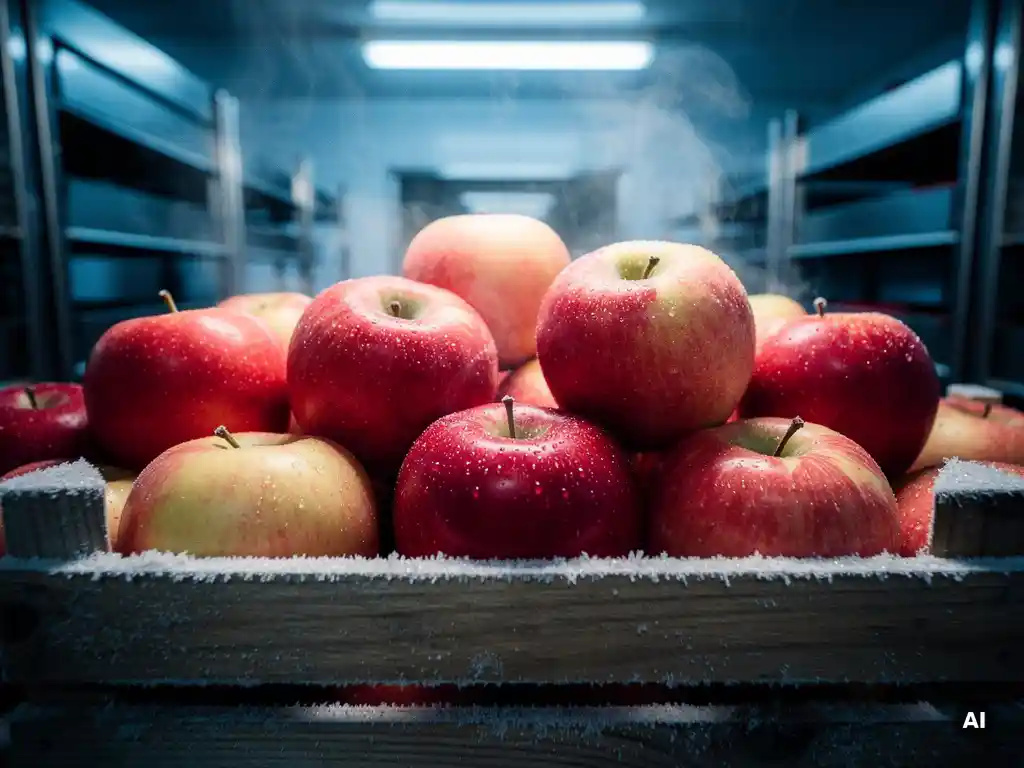
Fruit varieties best suited for long cold chains share a common set of traits: firm flesh, low ethylene sensitivity, thick skin, and the ability to maintain flavour and texture over extended storage periods. Apples generally outperform most other fruits in this regard, with certain cultivars remaining market-ready after six to twelve months in controlled atmosphere storage. Pears can also handle long cold chains well, though they require more careful management. Below, we unpack the key questions around cold chain performance, and if you want to explore variety-specific options, feel free to get in touch with us directly.
What makes a fruit variety suitable for long cold chains?
A fruit variety is suitable for long cold chains when it can maintain its structural integrity, flavour profile, and visual appeal over extended periods of refrigerated transport and storage. The most critical traits are flesh firmness, low susceptibility to physiological disorders like bitter pit or internal browning, and a naturally slow ripening rate driven by low ethylene production.
Beyond ethylene sensitivity, skin thickness and wax composition play a significant role. A robust cuticle reduces moisture loss and slows microbial entry, both of which become increasingly important the longer fruit spends in transit. Varieties that bruise easily or lose crunch quickly are simply not viable candidates for long cold chains, regardless of how well they taste at harvest.
Genetic background also matters. Varieties with a high proportion of firm-fleshed parentage tend to inherit structural resilience that holds up under temperature fluctuations, an unavoidable reality in real-world logistics. This is why modern apple and pear breeding programs increasingly screen for cold chain performance as a core trait rather than an afterthought.
Which apple varieties perform best in long cold storage?
Apple varieties that perform best in long cold storage are typically those with dense, firm flesh, low ethylene production, and strong resistance to common storage disorders. Cultivars in the Fuji, Braeburn, and Pink Lady families have long been recognised for their storage longevity, but newer club varieties bred specifically for these traits are increasingly setting the benchmark.
Among our own portfolio, Kanzi® has demonstrated strong cold storage performance across multiple markets, maintaining its characteristic crunch and balanced sweet-tart flavour well into the season. The variety’s firm texture and relatively low ethylene sensitivity make it a reliable choice for exporters and retailers managing longer supply windows.
More recently, varieties like Morgana® and Giga® have been developed with cold chain performance built into their breeding profile from the outset. These cultivars reflect a shift in how we approach variety development: cold chain suitability is now evaluated alongside taste, yield, and disease tolerance rather than being tested retrospectively.
Key characteristics to look for in any cold-chain-suitable apple variety include:
- High flesh firmness at harvest and after extended storage
- Low ethylene production and sensitivity
- Resistance to bitter pit, lenticel breakdown, and internal browning
- Stable sugar-acid balance over time
- Minimal susceptibility to superficial scald
How does apple breeding improve cold chain resilience?
Apple breeding improves cold chain resilience by selecting parent combinations and individual seedlings that carry the genetic traits linked to extended storage performance. Using tools like molecular markers, breeders can identify these traits early in a seedling’s development, long before fruit is produced, dramatically accelerating the selection process.
At Better3Fruit, we evaluate over 30,000 new varieties at any given time, with 10,000 new seedlings of each crop entering the field every year. Within that pipeline, cold chain performance is assessed systematically. Seedlings are screened not just for taste and yield at harvest, but for how they hold up after weeks and months in cold storage, because a variety that tastes exceptional in October but loses its texture by January has limited commercial value in global supply chains.
Molecular marker technology has been particularly transformative here. By identifying genetic markers associated with flesh firmness, ethylene pathway regulation, and disorder resistance, we can prioritise the most promising candidates much earlier in the breeding cycle. This means fewer resources are spent on varieties that would ultimately fail cold chain evaluation, and more attention goes to cultivars with genuine long-term commercial potential.
Climate resilience is also becoming an increasingly important dimension of cold chain breeding. As growing seasons shift and harvest timing becomes less predictable, varieties that can tolerate variable pre-harvest conditions while still delivering consistent storage performance are gaining real commercial advantage.
What’s the difference between controlled atmosphere and standard cold storage for fruit?
The key difference between controlled atmosphere (CA) storage and standard cold storage is that CA storage actively manages the composition of the air surrounding the fruit, reducing oxygen levels and increasing carbon dioxide concentrations to slow respiration and ethylene production. Standard cold storage simply uses low temperature alone to slow ripening.
In practical terms, this distinction has a significant impact on how long a variety can remain market-ready. Standard refrigeration typically extends apple shelf life by two to four months beyond harvest. Controlled atmosphere storage, by contrast, can extend that window to eight, ten, or even twelve months for the right varieties, while preserving firmness, colour, and flavour far more effectively.
Not all varieties respond equally well to CA storage. Some cultivars are sensitive to elevated carbon dioxide and develop internal disorders if CA parameters are not carefully calibrated. This is another reason why variety selection matters so much in cold chain planning: a variety bred with CA storage compatibility in mind will perform very differently from one selected purely for field performance.
For exporters and retailers managing long supply chains across multiple continents, CA storage is often the enabling technology that makes certain varieties commercially viable at all. Without it, the storage window for even the best-performing cultivars would be too narrow to support year-round availability.
Can pear varieties handle long cold chains as well as apples?
Pear varieties can handle long cold chains effectively, but they require more precise management than most apples. Unlike apples, many pears are climacteric fruits that ripen relatively quickly once removed from cold storage, which means the cold chain itself must be maintained more consistently to avoid premature softening or breakdown before the fruit reaches the consumer.
Conference, the most widely grown European pear variety, is a good example of a cultivar with solid cold storage credentials. Under controlled atmosphere conditions, Conference can be stored for several months while retaining acceptable quality. However, the ripening window once removed from storage is short, which places greater demands on the downstream supply chain.
At Better3Fruit, our pear breeding program applies the same rigorous approach to cold chain performance as our apple work. We look for varieties that combine extended storage potential with a manageable and predictable ripening profile after removal from cold storage. A pear that stores well but ripens unevenly or too rapidly is difficult to commercialise at scale.
The honest answer is that apples currently have a broader range of commercially proven long cold chain varieties than pears, partly because pear breeding has historically received less investment globally. That gap is narrowing as breeding programs like ours bring more cold-chain-optimised pear cultivars through evaluation. You can explore our current apple and pear varieties to see what we have in development and commercial release.
Choosing the right variety for a long cold chain is one of the most consequential decisions a grower, packer, or retailer can make. It affects not just storage costs and logistics, but ultimately the eating experience that reaches the consumer at the end of the chain. Whether you are evaluating apple or pear options for a long-distance supply chain, we are happy to help you find the right fit. Get in touch with us to discuss your cold chain requirements and explore which varieties best match your market and logistics needs.
This content was generated with the help of AI and it may contain mistakes