
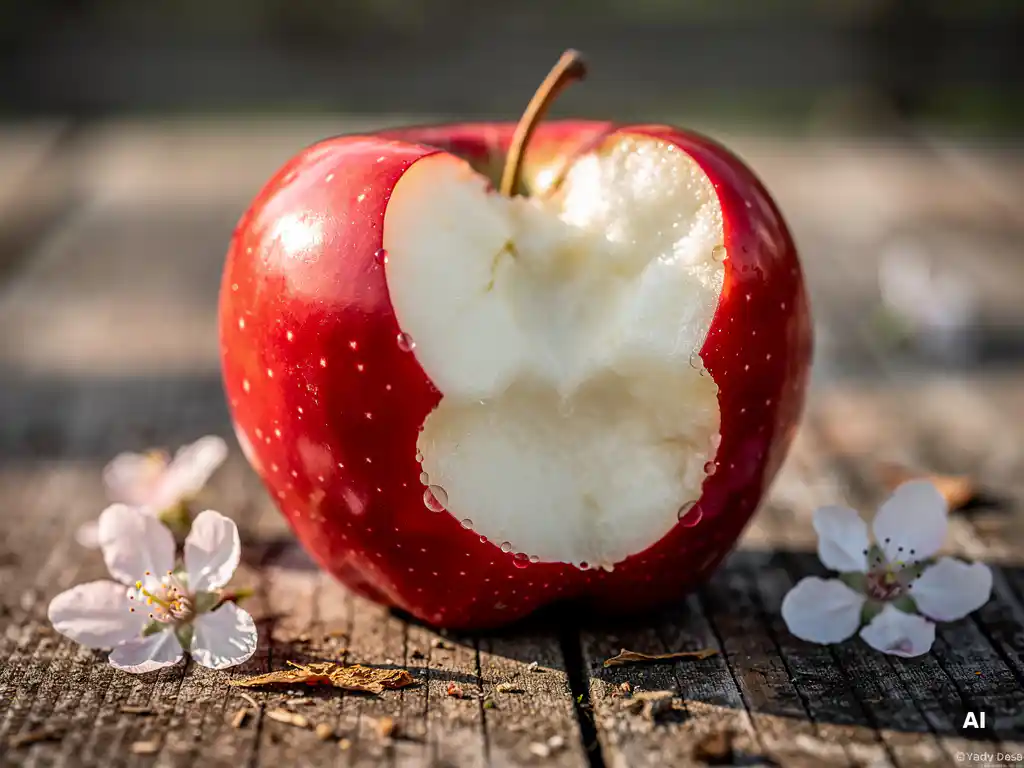
An apple is crunchy because of its cellular structure. Each apple cell is filled with water and surrounded by a firm cell wall made of cellulose and pectin. When you bite into a crunchy apple, thousands of those pressurized cells rupture simultaneously, releasing juice and creating the sharp, satisfying snap that defines apple texture. The variety, water content, and how the fruit has been stored all shape how crunchy an apple actually feels. The sections below unpack each of those factors in detail, and explain how crunchiness can even be deliberately bred into a variety. Feel free to get in touch with us if you have questions about apple breeding or variety development.
What actually happens inside an apple when you bite into it?
When you bite into a crunchy apple, you are rupturing thousands of tightly packed, water-filled cells all at once. Each cell acts like a tiny pressurized balloon. The force of your bite causes them to burst, releasing juice and creating the characteristic snap. The crunchiness you perceive is the combined result of cell wall rigidity, internal cell pressure (called turgor pressure), and how densely those cells are packed together.
Apple flesh is made up of parenchyma cells, large, thin-walled cells that store water and nutrients. In a firm, crunchy apple, these cells are plump, tightly bonded to one another, and under high turgor pressure. The cell walls themselves are reinforced with pectin, a natural structural compound that acts like a biological glue between cells. When the bonds between cells are strong and the cells themselves are full, the apple resists deformation until the pressure threshold is crossed, and then it breaks sharply rather than squashing softly. That sharp break is what we experience as crunch.
In a mealy or soft apple, the same cells are present, but the bonds between them have weakened, the turgor pressure has dropped, or both. Instead of rupturing cleanly, the cells slide apart or collapse gradually. The result is a soft, floury texture with no satisfying snap.
What role does water content play in apple crunchiness?
Water content is central to apple crunchiness because it directly controls turgor pressure, the internal force that keeps each cell firm and taut. A well-hydrated apple cell is under tension, like an inflated balloon. That tension is what gives the cell its rigidity and makes it burst sharply when bitten. Without adequate water, cells deflate, turgor pressure drops, and the apple loses its firm, crisp texture.
This is why apples that have been left out at room temperature for even a day or two begin to feel softer. They are losing moisture through their skin, and as water content falls, so does the pressure inside each cell. The apple does not change its sugar content or flavor dramatically in that time, but the textural shift is immediate and noticeable.
It is worth noting that water content alone does not guarantee crunchiness. The structural integrity of the cell walls and the bonds between cells matter equally. An apple with high water content but weakened pectin bonds will still feel soft. Apple texture is the product of water content and cell wall strength working together.
Why do some apple varieties stay crunchy longer than others?
Some apple varieties stay crunchy longer because of genetic differences in their cell wall composition, pectin structure, and the rate at which those walls break down after harvest. Varieties with naturally thicker cell walls, stronger pectin bonds, and slower rates of enzymatic activity retain their firm texture for weeks or months longer than softer varieties.
The enzyme polygalacturonase plays a key role here. It breaks down pectin in the cell wall, weakening the bonds between cells and causing the flesh to soften. Varieties that produce less of this enzyme, or produce it more slowly, hold their crunch for longer. This is a heritable trait, it is encoded in the apple’s genetics, which means it can be selected for during breeding.
Variety also influences how the apple responds to ethylene, the natural ripening hormone that triggers cell wall breakdown. Some varieties are more sensitive to ethylene than others, meaning they soften faster after harvest even under identical storage conditions. A variety like Kanzi®, developed through our breeding program, is known for its dense, crunchy flesh and good post-harvest texture retention, qualities that reflect deliberate selection for cell structure traits over many breeding cycles.
How does storage affect an apple’s crunch over time?
Storage conditions have a major impact on how long an apple stays crunchy. Cold temperatures slow down the enzymatic processes that break down cell walls, which is why refrigerated apples stay firm far longer than apples left at room temperature. Controlled atmosphere (CA) storage, which reduces oxygen levels and increases carbon dioxide, goes further by suppressing ethylene production and slowing respiration, preserving apple texture for months after harvest.
Without proper storage, the breakdown process accelerates quickly. At room temperature, ethylene builds up around the fruit, cell wall enzymes become more active, and turgor pressure drops as moisture is lost through the skin. The apple softens from the inside out, and no amount of refrigeration after the fact can fully reverse that process once significant cell wall degradation has occurred.
For consumers, the practical takeaway is straightforward: keep apples cold, ideally in the refrigerator rather than a fruit bowl, and store them away from other ethylene-producing fruits like bananas. For commercial growers and packers, CA storage is the industry standard for maintaining apple firmness across a long selling season.
Can apple crunchiness be bred into a variety on purpose?
Yes, apple crunchiness can be deliberately bred into a variety. Cell wall composition, turgor pressure, and the rate of post-harvest softening are all heritable traits, meaning they are passed from parent to offspring and can be selected for across breeding generations. Modern apple breeding programs use a combination of traditional cross-pollination and molecular marker technology to identify and select seedlings that carry the genetic traits associated with firm, crunchy flesh.
Molecular markers allow breeders to screen thousands of seedlings at an early stage, before the trees ever produce fruit, by identifying DNA sequences linked to desirable texture traits. This dramatically speeds up the breeding process, which would otherwise require waiting years for each generation of trees to mature and fruit before selection could happen.
At Better3Fruit, we have built our entire breeding strategy around traits like these. With over 30,000 new varieties under evaluation at any given time, we use molecular tools to accelerate the identification of seedlings that combine the texture, flavor, and disease tolerance traits that growers and consumers actually want. Explore our apple varieties to see how these breeding priorities translate into commercial fruit. Crunchiness is not an accident in a well-bred apple, it is the result of generations of careful selection. If you want to learn more about how we approach variety development, contact us to start a conversation.
This content was generated with the help of AI and it may contain mistakes