
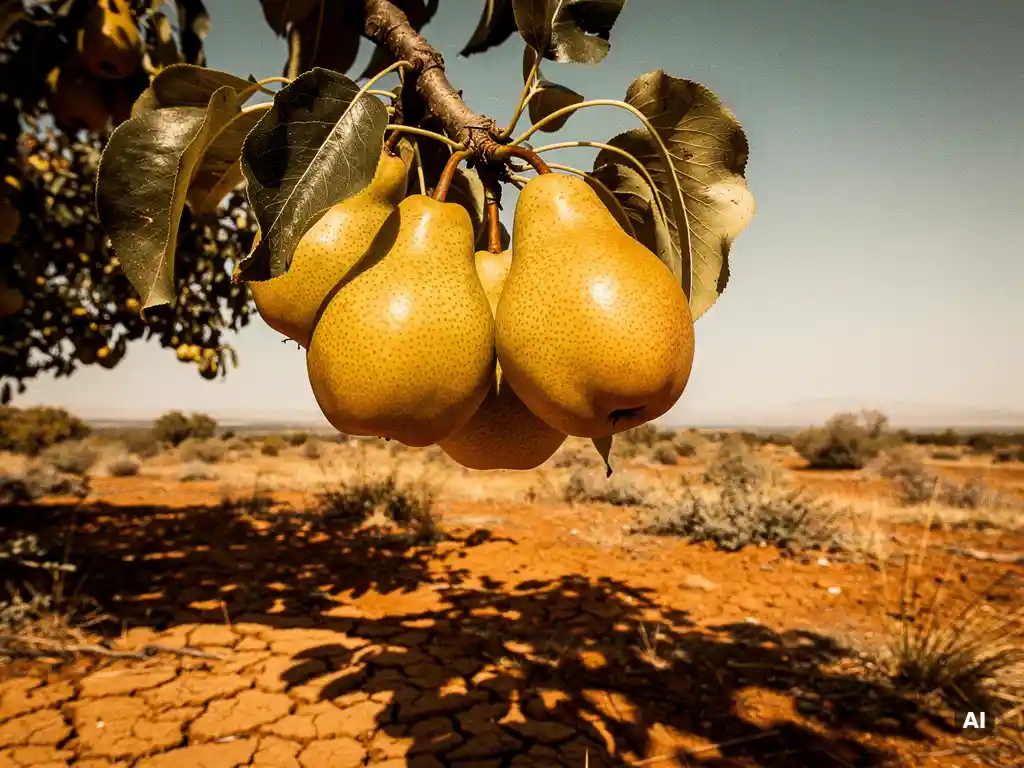
Several pear varieties are well suited to dry, warm regions, particularly those with Asian pear genetics or rootstocks adapted to low-chill, drought-prone conditions. Varieties with lower chilling requirements, strong heat tolerance, and the ability to set fruit reliably without extended cold winters perform best in these environments. The sections below address the most important questions growers face when selecting and managing pears in arid or semi-arid climates.
If you are exploring new pear varieties for a warm or dry growing region and want to discuss what might work for your specific situation, feel free to get in touch with us directly.
What makes a pear variety suitable for dry, warm climates?
A pear variety is suitable for dry, warm climates when it combines a low chilling requirement, strong heat tolerance during flowering and fruit development, and efficient water use. Varieties that can complete dormancy with fewer cold hours, set fruit reliably in warm springs, and maintain fruit quality under heat stress are the most practical choices for arid and semi-arid growing regions.
Beyond temperature tolerance, drought-tolerant pear varieties tend to have deeper root systems that access subsoil moisture more effectively, and they show less fruit drop or sunburn damage when temperatures spike during summer. Skin characteristics also matter: varieties with thicker or russeted skin tend to handle low humidity and high evapotranspiration better than thin-skinned types.
Flavor and texture under heat stress are equally important commercial considerations. Some varieties that perform beautifully in cool, humid conditions develop mealy or bland flesh when grown in high temperatures. Selecting varieties that maintain their eating quality across a wide temperature range is essential for growers who want to produce marketable fruit in warm climates.
Which pear varieties perform best in low-chill environments?
In low-chill environments, Asian pear varieties and hybrids between Asian and European pears generally outperform traditional European cultivars. Asian pears such as Pyrus pyrifolia-based selections typically require fewer than 400 chilling hours, making them reliable producers in regions where winters are mild. Some low-chill European-type selections have also been developed specifically for warmer production zones.
Among Asian pears, varieties like Hosui, Shinseiki, and Kosui have established track records in warm climates across the Middle East, North Africa, and parts of southern Europe and Australia. They fruit reliably without deep winter cold and tend to produce well even when chilling accumulation is inconsistent from year to year.
Hybrid pears that combine the low-chill adaptability of Asian species with the flavor profile of European pears represent an exciting frontier. These crosses aim to deliver the buttery, aromatic flesh that consumers associate with European pears while tolerating the warmer winters common to Mediterranean, subtropical, and semi-arid growing zones. Breeding programs focused on this combination are actively expanding the range of commercially viable options for growers in heat-stressed regions.
How does rootstock choice affect pear performance in dry regions?
Rootstock choice significantly affects pear performance in dry regions by determining drought tolerance, root depth, anchorage, and the tree’s ability to access water and nutrients under stress. In arid conditions, rootstocks that develop deep, extensive root systems outperform those with shallow, fibrous roots, which are more vulnerable to surface soil moisture fluctuations.
Quince rootstocks, widely used in European pear production for their dwarfing effect and early cropping, are generally less suited to dry, hot conditions. They have shallower root systems and lower drought tolerance compared to seedling pear rootstocks. In warm, dry regions, Pyrus calleryana and Pyrus betulifolia-based rootstocks are often preferred because they are more vigorous, deeply rooted, and significantly more tolerant of heat, drought, and alkaline soils.
The compatibility between rootstock and scion variety also influences performance. Not all heat-resistant pear varieties graft successfully onto all rootstocks, and poor graft compatibility can reduce tree longevity and productivity regardless of how well the rootstock handles dry conditions. Growers should confirm compatibility before committing to a rootstock-variety combination at scale.
Can European pear varieties adapt to warm, dry growing conditions?
Most traditional European pear varieties struggle in warm, dry growing conditions because they were bred for cool, humid climates with reliable chilling accumulation. However, some European cultivars show moderate adaptability when supported by careful site selection, rootstock choice, and irrigation management. Varieties like Coscia and Spadona have demonstrated better performance in warmer Mediterranean zones than classic cultivars such as Conference or Doyenné du Comice.
The core challenge for European pears in warm climates is insufficient chilling. Without adequate cold hours during dormancy, trees may bloom erratically, set fruit poorly, or produce undersized, low-quality fruit. In regions where chilling is borderline, growers sometimes apply hydrogen cyanamide or other dormancy-breaking treatments to compensate, though this adds management complexity and cost.
Breeding is gradually expanding the range of European-type pears that can succeed in warmer zones. New selections developed with molecular tools can combine the flavor characteristics that consumers expect from European pears with the genetic traits that confer lower chilling requirements and heat resilience. This is an area where modern breeding programs, including our own work at Better3Fruit, are investing significant effort to widen the options available to growers in challenging climates.
What irrigation strategies support pear cultivation in arid regions?
In arid regions, pear cultivation depends on efficient, targeted irrigation strategies that deliver water precisely when and where trees need it. Drip irrigation and micro-sprinkler systems are the most effective approaches because they minimize evaporation, reduce weed pressure, and allow growers to manage soil moisture levels closely throughout the growing season.
Deficit irrigation during key growth stages
Regulated deficit irrigation is a well-established strategy for pear production in dry climates. By deliberately reducing water supply during specific growth stages, growers can manage vegetative vigor, improve fruit color and firmness, and reduce overall water consumption without significantly compromising yield. The critical period to avoid water stress is from bloom through cell division, typically the first six to eight weeks after flowering, when fruit size is being determined.
Soil moisture monitoring and scheduling
Effective irrigation management in arid pear orchards relies on continuous soil moisture monitoring rather than fixed scheduling. Tensiometers, capacitance probes, or pressure chambers used to measure leaf water potential give growers real-time data to adjust irrigation timing and volume. This prevents both overwatering, which can promote root disease and excessive shoot growth, and underwatering, which leads to fruit drop, poor sizing, and reduced return bloom.
Mulching the root zone with organic or reflective materials also reduces soil evaporation significantly, extending the interval between irrigations and buffering soil temperature during heat events. In combination with efficient drip systems and soil monitoring, mulching can meaningfully reduce total water use while keeping trees productive.
Selecting the right pear variety for a dry, warm region is a decision that depends on chilling availability, soil type, rootstock compatibility, and the commercial market you are targeting. We are happy to discuss the options that best fit your specific growing conditions. Contact us to explore what our breeding program can offer for your region, or browse our current variety portfolio to see what is already available.
This content was generated with the help of AI and it may contain mistakes