
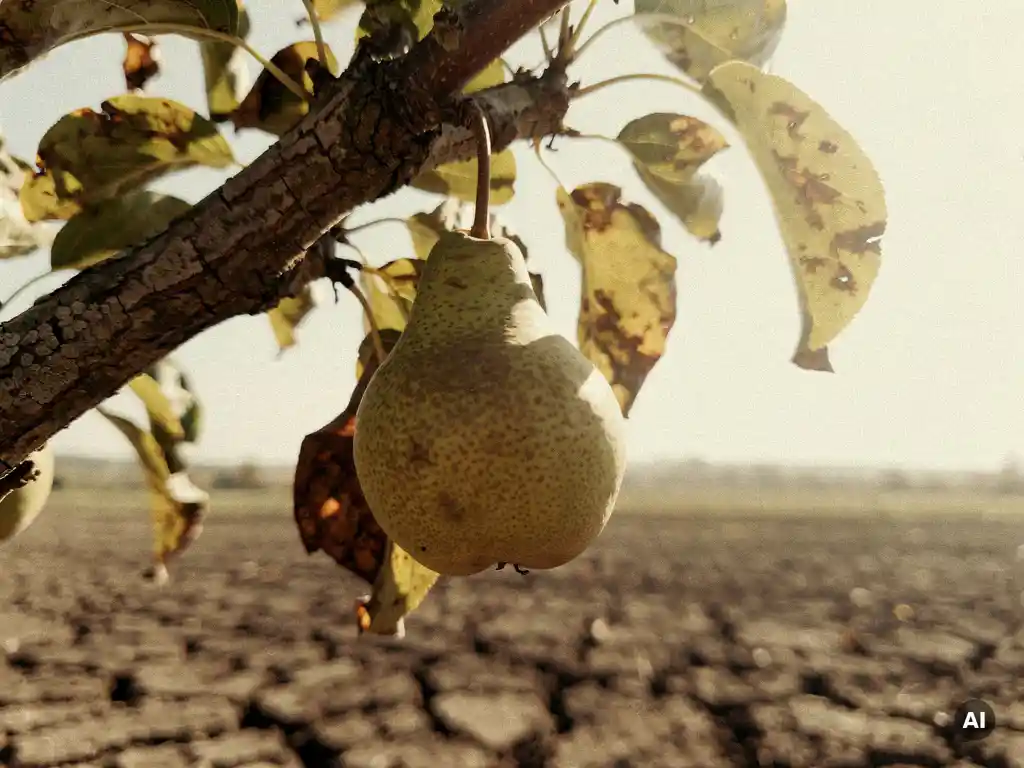
Pears grow less well in warm climates primarily because they require a sustained period of cold winter temperatures to complete their natural dormancy cycle. Without enough chilling hours, pear trees struggle to flower evenly, set fruit reliably, and maintain their overall health. If you are curious about how this affects variety selection or breeding work, feel free to get in touch with us, and we are happy to help.
This article unpacks the science behind pear chilling requirements, what goes wrong when winters are too mild, how pears compare to apples in heat tolerance, and what plant breeding is doing to change the picture.
What makes pears so dependent on cold temperatures?
Pears are dependent on cold temperatures because they have a biological need called a chilling requirement, a minimum number of hours spent below roughly 7°C (45°F) during winter dormancy. This cold exposure triggers the hormonal reset that allows the tree to break dormancy uniformly in spring, producing well-timed flowering and consistent fruit set. Most commercial pear varieties need between 800 and 1,500 chilling hours per season.
This requirement is not a quirk but an evolutionary adaptation. Pears (Pyrus communis and related species) originated in temperate regions of Europe and Central Asia where cold winters are the norm. Over thousands of years, pear trees evolved to use cold as a reliable seasonal signal. The cold period suppresses a growth inhibitor called abscisic acid and allows the accumulation of compounds that enable buds to open. Without that signal, the tree’s internal calendar stays out of sync with the actual growing season.
In practical terms, pear cultivation temperature matters enormously at the planning stage. A site that averages only 400 to 500 chilling hours in winter is simply not well matched to most European or Asian pear varieties, no matter how fertile the soil or how skilled the grower.
What happens to pear trees when winters aren’t cold enough?
When pear trees do not receive enough winter cold, they experience incomplete dormancy release. The most visible symptom is erratic or delayed budbreak: some buds open weeks after others, or some fail to open at all. Flowering becomes staggered and sparse, pollination is disrupted, and fruit set drops sharply. In severe cases, trees may produce almost no crop despite appearing otherwise healthy.
Beyond the immediate harvest impact, pear heat stress accumulates over multiple seasons. Trees that repeatedly fail to meet their chilling requirement become progressively weaker. Leaf canopy development is uneven, which reduces photosynthesis and limits the energy available for root development and fruit sizing. Pest and disease pressure also tends to increase because stressed trees have reduced natural defences.
In regions where warming winters are becoming the norm, growers sometimes apply hydrogen cyanamide or other dormancy-breaking agents to compensate. These treatments can help in mild shortfalls, but they are not a substitute for adequate natural chilling and add cost and complexity to production. The underlying pear growing conditions problem remains unsolved by chemistry alone.
Why do apples cope better with warm climates than pears?
Apples generally cope better with warm climates than pears because apple varieties span a much wider range of chilling requirements, including many low-chill cultivars bred specifically for mild winters. While standard European pear varieties typically need 800 or more chilling hours, some apple varieties perform well with fewer than 400. This gives apple breeding programs more genetic material to work with when targeting warmer regions.
There are also biological differences between the two crops. Apples show greater natural genetic diversity in their chilling response, partly because Malus species evolved across a broader range of climates than most commercial pear species. The pear gene pool used in mainstream breeding has historically been narrower, which has limited the development of genuinely low-chill pear varieties.
It is worth noting that even apples have limits. In regions with very warm winters, apple production without artificial chilling or low-chill varieties also becomes unreliable. The difference is one of degree: the apple toolbox for warm climates is currently larger and more commercially proven than the equivalent pear toolbox.
Are there pear varieties that grow well in warm climates?
Yes, some pear varieties perform reasonably well in warm climates, but the options are more limited than for apples. Asian pear species such as Pyrus pyrifolia and Pyrus bretschneideri tend to have lower chilling requirements than European pears and are better suited to milder winters. Among European-type pears, varieties like Flordahome and Hood were specifically selected for low-chill performance in subtropical climates.
However, “grows in warm climates” and “thrives commercially in warm climates” are not the same thing. Many low-chill pear varieties compromise on fruit quality, storability, or disease resistance compared to premium European cultivars. Growers in warm regions often face a trade-off between climate adaptability and the eating quality that consumers and retailers expect.
You can explore the range of varieties we have developed and licensed globally on our varieties overview, which gives a sense of the direction modern breeding is taking in terms of combining quality with broader adaptability.
How is plant breeding addressing pear climate resilience?
Plant breeding is addressing pear climate resilience by identifying and incorporating genetic traits that reduce chilling requirements without sacrificing fruit quality. Modern breeding programs use molecular markers to screen large populations of seedlings for low-chill characteristics at an early stage, long before a tree ever bears fruit. This dramatically speeds up the selection process compared to traditional field observation alone.
At Better3Fruit, climate resilience is one of our primary long-term breeding goals alongside disease tolerance and taste. We evaluate over 30,000 new pear and apple varieties at any given time, which gives us a large genetic canvas to work with when searching for individuals that combine warm-weather adaptability with the flavour, texture, and yield that growers and consumers demand. Pear breeding for climate is a long-term effort: a single breeding cycle can take a decade or more from cross to commercial release, but the genetic tools available today make the search far more efficient than it was even twenty years ago.
Beyond chilling requirements, pear breeding climate work also targets heat stress tolerance during the growing season, earlier or later flowering windows to avoid frost risk in transitional climates, and rootstock compatibility that supports tree performance in warmer soils. The goal is not a single “warm climate pear” but a portfolio of varieties matched to specific regional conditions around the world.
If you are a grower, licensor, or industry partner interested in what the next generation of climate-adapted pear varieties might look like, we would love to connect. Contact us to start a conversation about how our breeding program could be relevant to your region and goals.
This content was generated with the help of AI and it may contain mistakes