
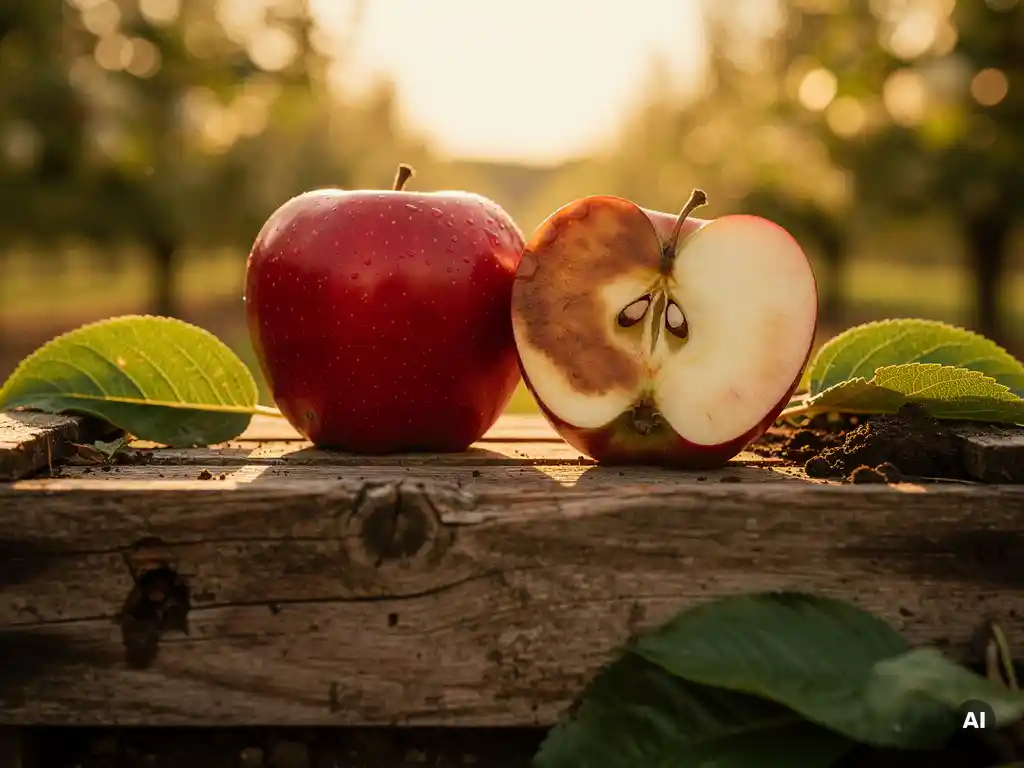
Some apple varieties lose their crunchiness quickly because their cell walls break down faster after harvest, driven by natural ripening processes and the release of ethylene gas. Varieties with thinner or less rigid cell walls are particularly prone to softening, while others are genetically built to hold their texture for weeks or even months. The sections below unpack the science behind apple texture, from cell structure to storage conditions to what modern breeding can do about it. If you have questions about apple varieties or want to learn more about what we do, feel free to get in touch with us.
What makes an apple crunchy in the first place?
Apple crunchiness comes from the structural integrity of individual fruit cells. Each cell is surrounded by a rigid wall made largely of cellulose and pectin, and filled with water-based fluid under pressure, a state known as turgor. When you bite into a firm apple, you are rupturing thousands of these pressurised cells simultaneously, which produces that satisfying crack and releases a burst of juice.
The apple’s cell structure is the foundation of its texture. Varieties with large, tightly packed cells and thick, pectin-rich walls tend to feel denser and crunchier. Varieties with smaller or more loosely arranged cells may feel softer or more floury even when freshly harvested. Beyond cell size and arrangement, the concentration of pectin, a naturally occurring carbohydrate that acts as a kind of biological glue between cells, plays a major role in how well an apple holds together under pressure.
Turgor pressure also matters enormously. An apple that has lost moisture, even slightly, will feel less crisp because the cells are no longer fully inflated. This is why a freshly harvested apple almost always feels firmer than one that has been sitting at room temperature for several days.
Why do some apple varieties lose firmness faster than others?
Some apple varieties lose firmness faster because they produce more ethylene, break down pectin more rapidly, or have cell walls that are structurally less resistant to softening. These traits are largely genetic, which is why texture retention varies so dramatically between varieties, even when they are stored under identical conditions.
Varieties like Golden Delicious are well known for softening relatively quickly after harvest. Their pectin degrades faster and their cell walls offer less structural resistance as ripening progresses. In contrast, varieties bred or selected for long-term storage tend to have denser cell structures and slower ethylene responses, which allows them to hold their texture for significantly longer periods.
The ripening stage at harvest also matters. Apples picked earlier in their ripening window tend to stay firmer for longer because the enzymatic processes that break down cell walls are less advanced. Varieties that are difficult to harvest at a consistent maturity stage can show wide variation in how quickly individual fruits soften after leaving the orchard.
How does ethylene cause apples to go soft?
Ethylene causes apples to go soft by triggering the production of enzymes, particularly polygalacturonase and pectinase, that break down pectin in the cell walls. As pectin degrades, the bonds between cells weaken, cell walls lose rigidity, and the apple transitions from firm and crunchy to soft and mealy. This process is a normal part of fruit ripening but varies in speed between varieties.
Ethylene is a naturally occurring plant hormone that apples produce themselves, and its production accelerates as the fruit matures. Once ethylene levels rise above a certain threshold, the ripening cascade becomes self-reinforcing: more ethylene triggers more enzyme activity, which further softens the tissue, which in turn signals more ethylene production.
This is also why storing apples near other ethylene-producing fruits, such as bananas or pears, can cause them to soften faster. The external ethylene from neighbouring fruit adds to the apple’s own output, speeding up the softening process. Conversely, technologies that block ethylene perception, such as 1-methylcyclopropene (1-MCP) treatments used in commercial storage, can significantly slow softening by interrupting this hormonal signal.
Does storage temperature affect how quickly apples lose their crunch?
Yes, storage temperature has a major effect on how quickly apples lose their crunch. Lower temperatures slow down the enzymatic activity that breaks down cell walls and reduce ethylene production, which is why commercially stored apples kept near 0°C can maintain their crunchiness for months. At room temperature, the same variety may become noticeably soft within days or weeks.
Controlled atmosphere (CA) storage takes this a step further by combining low temperature with reduced oxygen and elevated carbon dioxide levels. This environment suppresses both ethylene production and the activity of cell-wall-degrading enzymes, allowing certain varieties to retain their texture and flavour profile for up to a year after harvest. This is how consumers can access firm, crunchy apples year-round even from the previous season’s harvest.
Humidity also plays a role. Apples stored in low-humidity environments lose moisture through their skin, which reduces turgor pressure and makes them feel less crisp even if the cell walls themselves remain intact. Maintaining high relative humidity in storage, typically above 90%, helps preserve that fresh-picked firmness for longer.
Can apple breeding produce varieties that stay crunchy longer?
Yes, apple breeding can produce varieties that stay crunchy longer by selecting for traits such as slower ethylene production, stronger cell wall composition, and greater pectin stability. Modern breeding programs use molecular markers to identify these traits early in a seedling’s development, making it possible to prioritise texture retention alongside taste, disease resistance, and other commercial qualities.
At Better3Fruit, we work with over 30,000 new varieties under evaluation at any given time, and apple texture is one of the key traits we assess throughout the selection process. By combining traditional sensory evaluation with genetic tools, we can identify promising seedlings that are likely to hold their crunch well after harvest, long before they ever reach a commercial orchard.
Varieties like our own Kanzi® and Morgana® reflect years of selection for exactly this kind of quality, where great flavour and satisfying crunch are built into the genetics of the fruit rather than relying solely on storage technology to preserve them. The goal is a variety that delivers on texture whether it comes straight from a CA store in spring or from a consumer’s fruit bowl after a few days at home.
Breeding for long-lasting crunchiness is not a simple task, because many of the genes involved in cell wall structure and ethylene sensitivity are also linked to other traits like flavour development and skin colour. Finding the right combination requires patience, scale, and the kind of long-term breeding investment that produces genuinely better fruit over time. If you are curious about how we approach variety development or want to explore licensing opportunities, contact us and we will be happy to talk.
This content was generated with the help of AI and it may contain mistakes